
Writing · 7 min read
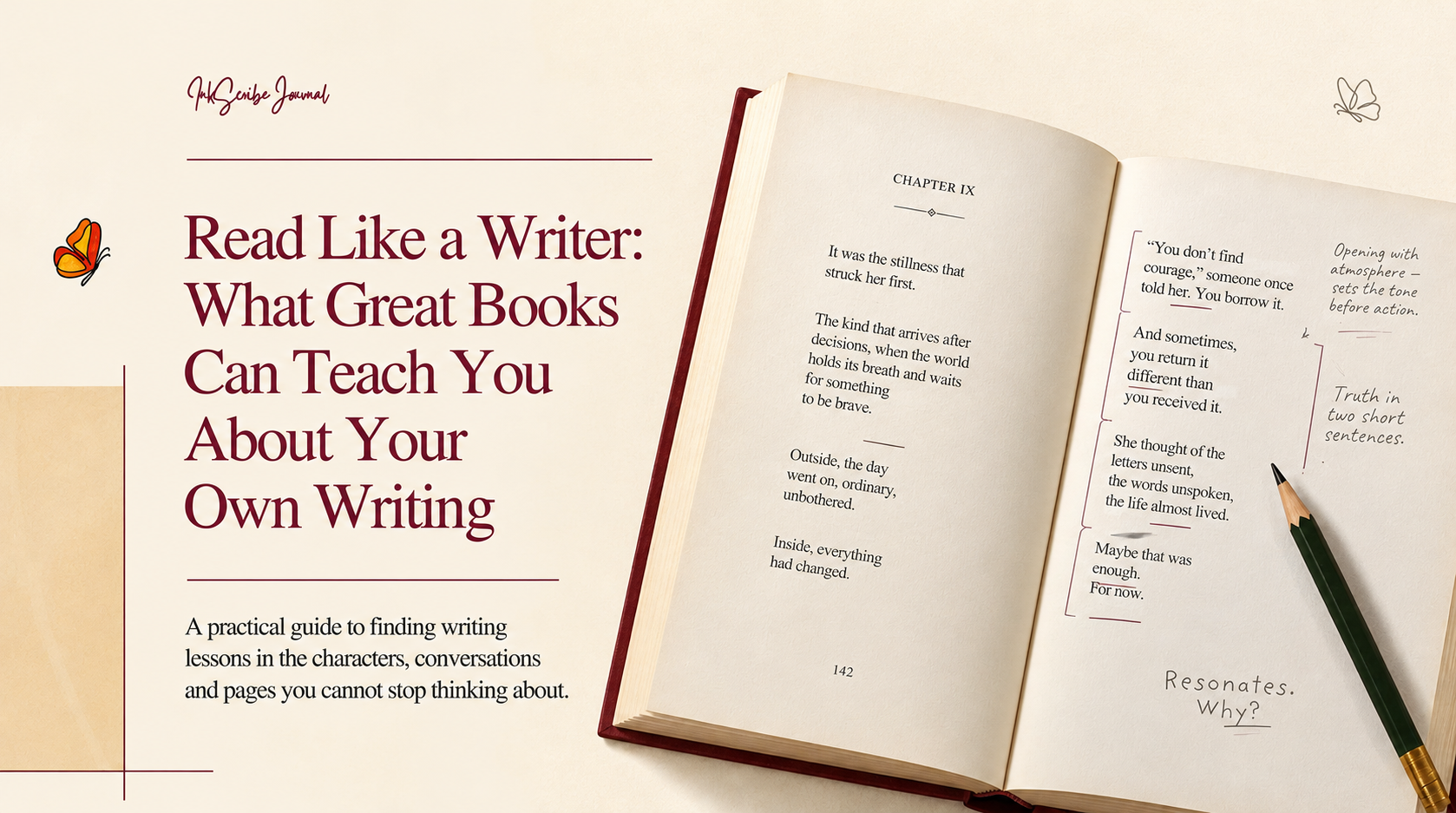
Read Like a Writer: What Great Books Can Teach You About Your Own Writing
A practical guide to finding writing lessons in the characters, conversations and pages you cannot stop thinking about.
By Lekshmi Baskar
There are books you finish and forget. And then there are books that follow you around for a while.
A character stays in your head. An ending annoys you for three days. A conversation between two people feels more real than half the conversations you had that week.
As a reader, you might say, “I could not put it down.” If you are also writing a book, there is another question worth asking:
How did the writer do that?
Reading like a writer means noticing the choices behind your reaction: how an author introduces a character, handles a conversation or decides what you get to know next.
You can still enjoy the story. Just go back occasionally to the page that made you feel something.
Start with what you felt
Take Sorrow and Bliss by Meg Mason.
For us, Martha is interesting because she can be funny, sharp and difficult to reach. The relationships around her can feel loving and exhausting at the same time. You can understand why someone loves her and why being close to her is hard.
Now let the writer in you enter the room.
How does Mason make that complexity believable? What do we learn through Martha’s behaviour, her memories and the way other people respond to her? How does humour sit alongside pain?
Those questions make a reaction useful to your own character writing.
The reader notices the feeling
“I was frustrated with her, but I still cared.”
The writer investigates the choice
“What did the author show me that kept me caring?”
Read first with your heart. Then go back with questions.
Coming soon: Writing Emotion Without Explaining Every Feeling: Lessons from Sorrow and Bliss
Follow the reason you turned the page
“Was the writing good?” can be a surprisingly unhelpful question. Try something more specific: What experience is this book creating, and HOW?
If a thriller keeps you reading at 1:14 in the morning, something on the page is making sleep seem negotiable.
Perhaps every answer creates another question. Perhaps a chapter ends just before the conversation you have been waiting for. Perhaps you know something the character does not.
Look at where your curiosity began and when the author satisfied it. Did the answer arrive immediately, or did you have to wait?
Then open your manuscript. What reason have you given the reader to continue? Are you resolving a question before it has had time to matter?
That is a much more useful lesson than deciding that all your chapters should be two pages long.
Look underneath an ordinary conversation
New writers sometimes feel that something enormous needs to happen constantly. A breakup. A revelation. A death. Preferably all before Chapter Five.
Yet a scene where two people eat breakfast can change everything.
Pay attention to what each person wants, what they avoid saying and what you already know about their relationship. An ordinary sentence can carry years of resentment if the story has prepared you to hear it.
Realistic dialogue also does more than reproduce everyday speech. Real life contains a lot of “umm” and discussions about where someone left the charger. Fiction usually needs the conversation to reveal something or change the situation.
A small example
She set out two cups. Then she put one back.
The first action establishes a habit. The second interrupts it. We might sense absence or loss, although neither feeling is named. The surrounding story would tell us which reading fits.
Try that question on a scene you love: What am I understanding that nobody has said aloud?
Watch how a character becomes real
When you meet someone, nobody hands you a paragraph explaining their personality. You notice how they speak to the waiter, what they avoid and the stories they tell about themselves.
Characters can work the same way.
Return to the first appearance of someone who felt vivid. Did you learn about them through description, a decision, dialogue or another person’s reaction? Did their actions contradict what they said?
Then check your own introduction. Have you given the reader something to observe, or explained everything before the character has done anything?
Readers like doing some of the work. Give them enough to form an impression, and room to revise it.
Notice what the author leaves out
A scene starts after an argument. Three years disappear between chapters. A painful event gets two sentences while an apparently insignificant object gets half a page.
Those are choices about attention.
Ask what the author skipped and what you could still understand. Then ask the uncomfortable version about your manuscript:
Does the reader need this scene, or did I need to write it to understand the story?
Both kinds of writing can be valuable. They do not both have to stay in the finished book.
This is also why copying a technique rarely teaches you enough. Short chapters might create urgency, shift perspective or control information. An unreliable narrator might make us question a character’s account.
Before borrowing the device, work out what it does in that particular book. Then decide whether your story needs it.
Try it on one page of your own
You do not need to analyse an entire novel or turn your bedside table into a research department.
Choose one short passage that stayed with you. Make a note of your response, identify one choice behind it and try that principle in your own work.
| What I felt | What I noticed | What I can try |
|---|---|---|
| Uneasy during a quiet conversation | One character avoided a direct question | Let someone evade a question in my scene |
| Curious at a chapter ending | The answer arrived after a pause | Test where my chapter ends |
| Close to a difficult character | A small action revealed vulnerability | Give my character a revealing action |
Treat these as experiments. Keep the change only if it helps your story.
If you like keeping notes, download our one-page reading notebook and try it with your next chapter.
You can learn from the books you actually want to read. Francine Prose explores close reading as a writing education in Reading Like a Writer. You do not need an approved bookshelf to begin.
And please still read a murder mystery purely because you want to know who did it.
When you start seeing your manuscript differently
You may notice that three characters sound suspiciously alike. Or that a chapter you love is beautifully written but contributes very little to the book.
That can be uncomfortable. It also gives you something specific to work on.
Sometimes you can revise it yourself. Sometimes distance or a trusted reader helps. When you can no longer see the shape of the book, manuscript assessment or developmental editing can offer an outside view of structure, character and pacing.
At InkScribe, that conversation can begin with the question you are already asking: “Is the reader experiencing what I intended?”
The next time a book stays with you
Before opening Goodreads or reaching for the next book, ask what happened to you while you were reading. Then look for the choices that made it happen.
That is where Read Like a Writer begins.
We will talk about the relationships that frustrate us and the characters we cannot forget. Then we will return to the page and look more closely.
Your next writing lesson might already be sitting on your bedside table.
Reading your own book differently now? Not sure what your manuscript needs? Tell us where it is right now. We will start there.
Where is my book right now?
Bring the book. We'll help name the need.
Wherever your manuscript is today, a short conversation is a good place to begin.
Talk to a publishing coach